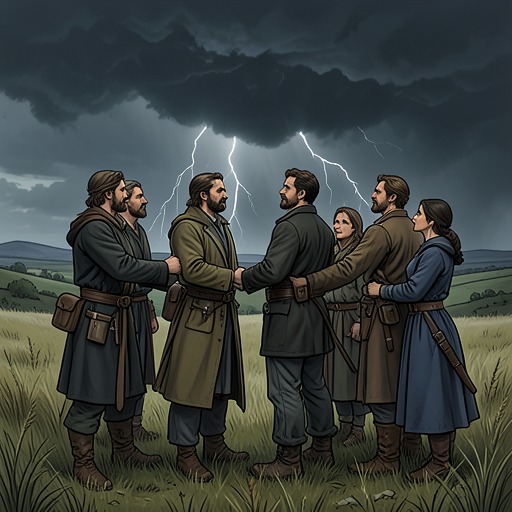
Renarin Kholin
The Way of KingsRenarin Kholin is the younger son of Dalinar Kholin and a prince of the Kholin family. He is introduced not through flamboyance or command, but through controlled attention: he watches, listens, pauses before speaking, and notices disturbances in the people around him. That quiet presence becomes decisive when his father’s visions threaten to remain private, frightening episodes. Renarin’s instinct is not to dismiss them or surrender to them, but to ask what they show and whether their truth can be tested.
Identity and Presence
Renarin appears in the royal hunting procession near the front, riding with his brother Adolin Kholin near the king and the highprinces. The column behind them is enormous— a thousand soldiers in Kholin blue, servants, and women traveling in palanquins to record the hunt—yet Renarin is characterized by reserve rather than spectacle. When he quietly asks whether they must ride at the front, Adolin answers that he wants to listen. Renarin’s position therefore places him close to power while his manner keeps him in the role of an attentive observer of it.
His speech is measured and deliberate. Adolin observes that Renarin pauses before answering as though testing each word in his mind, a habit that makes some women uneasy because they feel he is dissecting them with his thoughts. Adolin, by contrast, has never found his younger brother discomforting. The contrast establishes Renarin as someone whom others may misread: his stillness can look like emotional absence, while those closest to him recognize concentration and inward activity.
Family and the Problem of the Visions
Renarin is closely attuned to Dalinar’s troubled state. When Adolin speaks privately about their father’s episodes during the highstorm, Renarin confirms that he knows what happened. His answer does not offer an explanation; he admits that he does not know what the visions mean. That admission is important because it joins him to the family’s uncertainty rather than giving him premature authority. He recognizes the disturbance, shares the burden of knowledge, and refuses to disguise ignorance as certainty.
The relationship with Dalinar is also marked by danger and immediate concern. During the chasmfiend attack, Renarin rides across the rocky ground in a stiff blue Kholin uniform and calls out to his father, asking whether Dalinar is well and whether he can help. Dalinar responds by calling him a foolish boy and ordering him away from the threat. Renarin’s action is reckless in practical terms, but it reveals his willingness to move toward an endangered parent even when he lacks the martial dominance of the Shardbearers around him. His family loyalty is expressed through presence before it is expressed through victory.
Later, after Teshav withdraws displeased by Dalinar’s orders, Renarin immediately tells his father that she was not pleased. The remark shows his attention to the emotional and political consequences of Dalinar’s decisions. Dalinar explains that people want him fighting so he can win another Shardblade and award it to them, while recalling that he had already won a Parshendi Shardblade and Shardplate and given both to Elhokar Kholin to distribute to a useful warrior. Renarin is thus positioned beside the machinery of war without being reduced to its appetite for weapons and status.
From Observer to Investigator
Renarin’s most consequential contribution comes during the argument over whether Dalinar’s visions should be treated as a legitimate basis for action. While Dalinar struggles to contain his anger and clashes with Adolin, Renarin proposes proving whether the visions are true. His suggestion changes the terms of the conflict. The visions are no longer only private experiences that the family must either trust or reject; they become material that can be described, examined, and compared against the world.
When Dalinar asks what he means, Renarin leans forward with his hands clasped and requests precise information about what Dalinar sees. The gesture and the question embody his characteristic method: disciplined attention rather than theatrical conviction. He does not claim to possess the answer, and he does not attempt to overpower the competing voices in the room. Instead, he creates a procedure for dealing with the unknown. His role in the family’s response to the visions is therefore epistemic as well as emotional: he helps convert fear into inquiry.
Emotional Awakening and the Political Crisis
Renarin’s composure breaks when he reaches Navani Kholin in the staging area after Sadeas’s army returns without Dalinar’s army. Accompanied by a small honor guard of three men, he arrives wide-eyed and frantic, abandoning the expression of calm curiosity that usually defines him. He pleads with Navani for information, and she tells him that there is talk of a rout even though the returning soldiers do not appear to have endured one. His alarm is proportionate to the stakes: his father and the army are missing, while Torol Sadeas’s account already appears suspect.
This moment makes visible what his habitual reserve conceals. Renarin is not detached from the people and events he studies; he is deeply invested in them. His earlier calm is a mode of control, not evidence of indifference. When the threat to Dalinar becomes immediate and public, the controlled observer becomes a frightened son seeking the truth from the person most likely to know it.
Narrative Function and Significance
Renarin’s narrative importance lies in the tension between how he is seen and what he does. Others can mistake his pauses, stillness, and analytical attention for coldness or emotional emptiness, yet his actions repeatedly reveal concern: he listens beside Adolin, acknowledges knowledge of Dalinar’s episodes, approaches Dalinar during the chasmfiend attack, tracks the displeasure of those affected by his father’s orders, and panics when Dalinar’s army fails to return. His character links perception to responsibility.
He also serves as a bridge between private family experience and public crisis. Dalinar’s visions begin as troubling episodes observed by his sons, but Renarin’s proposal to test them gives those experiences a possible place within collective decision-making. At the same time, his presence in war scenes exposes the limits of rank and intention: being a prince does not make him invulnerable, and loving Dalinar does not give him the power to control the battlefield. Renarin’s significance is consequently not that he replaces stronger warriors, but that he notices what force alone cannot settle—the meaning of visions, the cost of decisions, and the human fear beneath political composure.